Thread Lifting Effectiveness: What Changes and Fades
Thread lifting can support mild laxity immediately, but duration depends on tissue quality, PDO or PCL material, and fixation design.
Key takeaways
- Thread lifting is a popular cosmetic option, and patient satisfaction can be high when candidates are appropriately selected.
- PDO threads typically last 6-12 months.
What is the reality of thread lift effectiveness?
Thread lifting is a popular option for facial rejuvenation, but setting realistic expectations is important.
The most natural outcomes usually come from correcting the direction of sagging, not from pulling the face as tightly as possible. A well-planned thread lift should soften heaviness in the lower face while preserving normal expression.
How long do thread lift results last by material?
Duration depends on the thread material.
PDO threads are usually described as lasting 6-12 month.
Longer duration does not automatically mean a better result. If the tissue is too thin, too heavy, or too lax, a longer-lasting thread may still fail to hold the desired shape.
The fading pattern is gradual. Most patients do not wake up one day with the lift gone. The visible lift settles slowly over time.
For patients comparing thread treatment with energy-based lifting, the material question is only one part of the decision. Devices such as Ultherapy PRIME target tissue tightening through focused ultrasound rather than thread fixation. Nohd Clinic explains the device-based route in more detail in its guide to Ultherapy PRIME in Seoul.

How do thread types and quantities affect the lift?
Thread design and thread count affect traction, but the correct vector matters more than simply placing more threads.
Mint Fine is chosen in Gangnam clinic searches because its fixation design is specific. Nohd Clinic's treatment catalog describes Mint Fine as using molded 360-degree 3D cogs designed to prevent the cogs from folding or snapping under pressure.
Jamber threads are used for a different kind of problem. Nohd Clinic's catalog describes Jamber as a spring-shaped coil thread for fine wrinkles and the eye area. Thin peri-orbital skin cannot be treated like a heavy jowl. The goal is subtle rejuvenation, not strong pulling.
The number of threads should be decided after mapping the vector of lift. In practical terms, the physician identifies where the tissue has dropped, where the thread can safely anchor, and which direction creates a natural contour. Too few threads may under-correct.
How can combination treatments and aftercare prolong results?
Combination treatment can support thread results when each modality has a separate role, such as lifting tissue and tightening skin.
Korean thread-lift techniques often combine Mint threads with Skin Botox or hyaluronic acid. The logic is practical: threads reposition tissue, while injectables or skin treatments can refine surface texture, expression-related tension, or volume support.
The Regener Package combines thread lifting with Ulthera Prime. This pairing makes sense when the lower face needs support from threads but the skin envelope also needs tightening.
Aftercare matters because early swelling, bruising, facial movement, and heat exposure can influence comfort and settling. Nohd Clinic offers patients to include aftercare such as LDM or Oxygen theraphy to help minimize swelling after thread lifting. Patients are advised to follow the clinic's recovery guidelinesA natural maintenance plan may combine collagen-stimulating devices, conservative injectables, thread support when needed, and skin-barrier care.
What happens during a thread-lift consultation at Nohd Clinic?
Nohd Clinic uses private consultation, vector design, local anesthesia, thread placement, and aftercare to keep outcomes realistic.
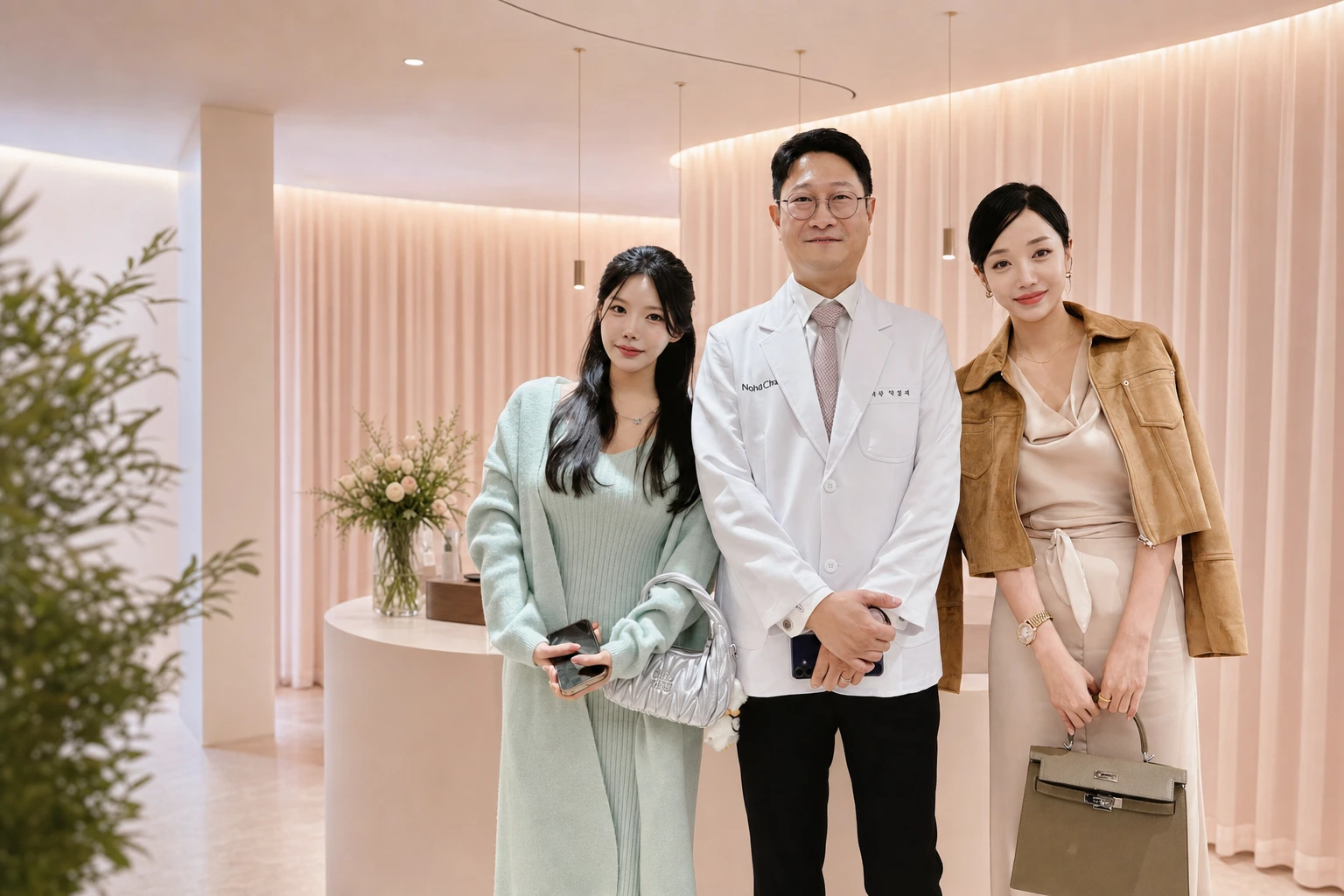
The first step is candidacy screening. Nohd Clinic's premium clinic experience includes private, sound-proof treatment suites and a security QR entry system for discretion. In a thread-lift consultation, privacy matters because the physician needs to assess facial movement, skin thickness, asymmetry, and the patient's tolerance for visible downtime.
- The clinician evaluates skin thickness, laxity, facial volume, and whether the tissue can hold thread fixation.
- The lift vector is designed for the jawline, mid-face, nasolabial fold, eye area, or a combination of zones.
- The thread type is selected, such as Mint Fine for stronger lower-face traction or Jamber Eye for thin peri-orbital skin.
- Local anesthesia is applied before thread insertion into the planned subcutaneous or deeper support layer.
- Cooling, hydration, LDM, Oxygen care, or other aftercare may be used to support recovery and reduce swelling.
The most important consultation outcome is not the number of threads. It is a clear decision about whether threads are the right tool. A conservative plan may recommend fewer threads, a staged approach, a device-first plan, or a surgical opinion if the anatomy is outside the useful range for thread lifting.
Nohd Clinic's aesthetic position is intentionally restrained: the face should look supported, not pulled. For international patients visiting Gangnam, that means the consultation should include what will change, what will fade, how much downtime to expect, and which alternatives may be more appropriate.
Plan a natural thread-lift consultation in Gangnam, Nohd Clinic
If your goal is subtle lower-face support, Nohd Clinic can assess skin density, lift vector, and the right thread type before recommending treatment.
FAQS
Frequently asked questions
Does thread lifting actually work?
Yes, thread lifting can work in selected mild to moderate laxity cases. It works by creating immediate mechanical support and then encouraging collagen formation around dissolvable threads. It is most useful when the patient wants subtle repositioning, not surgical skin removal.
How long does a thread lift last in your 30s?
A thread lift in your 30s commonly lasts around 12-18 months with PDO threads, while PCL threads may support results for up to 36 months in suitable anatomy (Thread Lift Korea, 2026). Skin density, facial movement, thread design, and aftercare all affect how quickly the result fades.
What is different about Mint Fine thread lifting in Gangnam clinics?
Mint Fine is known for molded 360-degree 3D cogs designed to resist folding or snapping under tissue pressure (Nohd Clinic Knowledge Base, 2026). In practice, that design is used for stronger traction in areas such as early jowls and nasolabial support.
Is thread lifting better than a mini facelift for early jowls?
Thread lifting is better suited to early jowls when the goal is subtle support without surgery. A mini facelift is more appropriate when excess skin removal, deeper structural repositioning, or longer-lasting surgical correction is the main goal.
Can thread lifting be combined with Ultherapy or Skin Botox?
Yes, combination treatment is common when each treatment has a distinct role. Threads can lift soft tissue, Ultherapy Prime can tighten the skin envelope, and Skin Botox or hyaluronic acid may be used selectively to refine surface tension or volume support.